HPL's Commonplace Book – 1926 (Papyrus Anastasi)
1926 : 141 Footnote by Haggard or Lang in "The World's Desire" "Probably the mysterious and indecipherable ancient books, which were occasionally excavated in old Egypt, were written in this dead language of a more ancient and now forgotten people. Such was the book discovered at Coptos, in the ancient sanctuary there, by a priest of the Goddess. 'The whole earth was dark, but the moon shone all about the Book.' A scribe of the period of the Ramessids mentions another in indecipherable ancient writing. 'Thou tellest me thou understandest no word of it, good or bad. There is, as it were, a wall about it that none may climb. Thou art instructed, yet thou knowest it not; this makes me afraid.' "Birch Zeitschrift 1871 pp. 61–64 Papyrus Anastasi I pl. X, l.8, pl. X l.4. Maspero, Hist. Anc. pp. 66–67."


This is the page in the 1894 book The World's Desire, by H. Rider Haggard and Andrew Lang, with the footnote Lovecraft is quoting:

Which in turn references footnotes on these pages in Gaston Maspero's 1886 work, Histoire ancienne des peuples de l'Orient pp. 66–67:


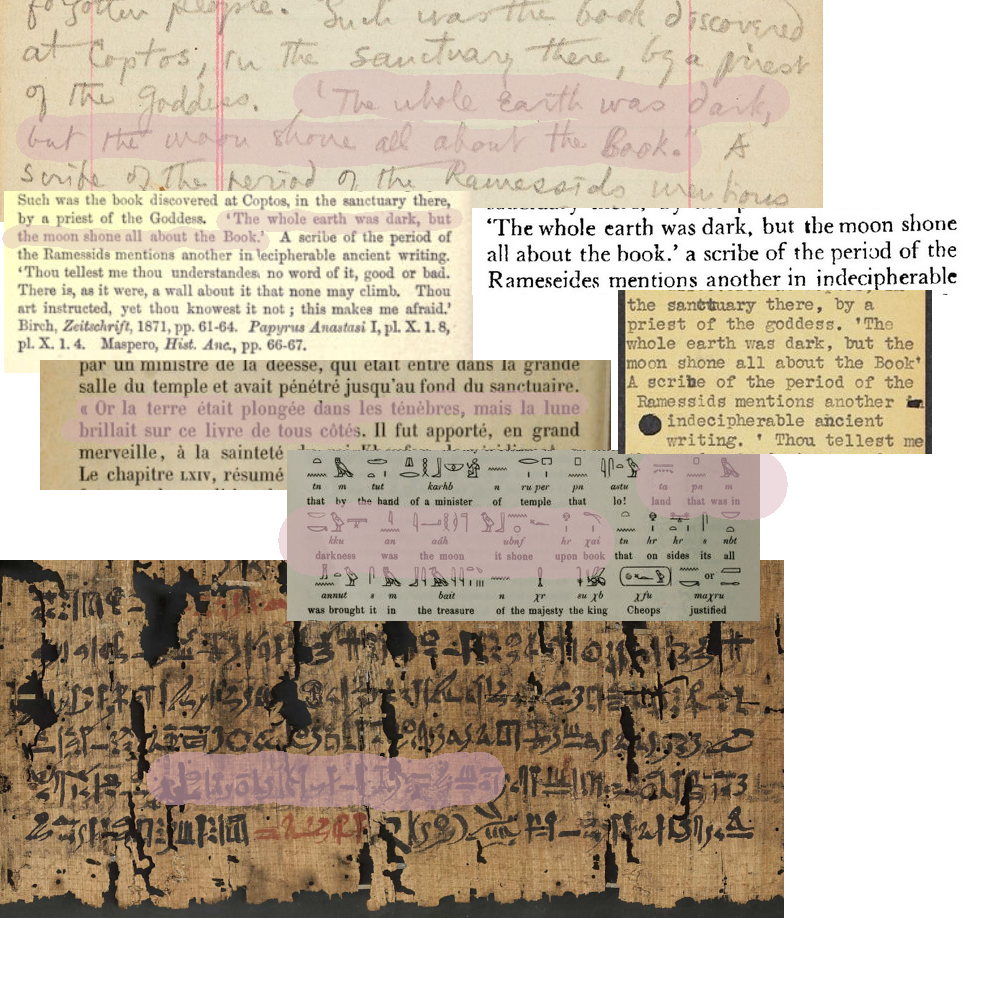
« Or la terre était plongée dans les ténèbres, mais la lune brillait sur ce livre de tous côtés. Il fut apporté, en grand merveille, à la sainteté du roi Khoufou, le véridique4. » (p.66)
Translated (by Haggard / Lang) as: 'The whole earth was dark, but the moon shone all about the Book.'
And the original passage as it appears in the article by S. Birch (1871):

The footnote on page 66 references this article by S. Birch, which Haggard/Lorn quotes as a reference in their footnote:


The feature that Haggard and Lane are specifically referencing, which is what captures Lovecraft's attention, is that the book was written in "a dead tounge of a dead people" (Haggard and Lane, The World's Desire p.64).
Maspero is discussing revelations from religious or scientific books, of which the medical treatise described by Birch is an example, where the described cure for a disease was discovered in a more ancient book.
The main notable feature of this papyrus to Birch is the mention of Cheops, the builder of the great pyramid, but the ritual formulae which are to be recited in conjuction with some of the cures "are not Egyptian, but transcripts into heiroglyphics of another language". Apparently a Semetic one; a "dialect of the Aramæan".
London Medical Papyrus: (11th / 10th c. BCE)


Papyrus Anastasi (13th c. BCE)

Tracing the quote 'The whole earth was dark, but the moon shone all about the Book.'